

You’ve found the flat or builder floor you like, haggled the price down, and shaken hands. Then the paperwork starts, and the number you agreed on slowly grows. Stamp duty, registration, brokerage, legal checks, a bit of renovation. None of it is secretive, but nobody puts it all in one place until you’re already committed.
This guide fixes that. Below, you’ll see how the cost of buying a property in Delhi is built, line by line, with two worked examples so you can plug in your own numbers.
What Is the Total Cost of Buying a Property in Delhi?
For a resale property, expect to pay roughly 8% to 12% on top of the agreed price. Government charges (stamp duty and registration) usually make up 6% to 7% of that. Brokerage, legal fees, loan processing, and first-year repairs fill the rest. Under-construction purchases can cost more because of GST.
The quick formula
Total cost = Agreement value + Stamp duty + Registration fee + Brokerage (with GST) + Legal fees + Loan charges + Repairs and interiors
Every term here is a line item you can ask about, negotiate or plan for.
Why the listing price is only the starting point
Most first-time buyers anchor on the price. That’s natural, but it’s how budgets break. Someone who stretches to the last rupee on a ₹1 crore flat often discovers they need another ₹8 to ₹11 lakh just to close the deal and move in. If you’re asking how much it costs to buy a property in Delhi, the honest answer is the price plus a cushion that you should calculate before you negotiate, not after.
How Do You Calculate a Property’s Actual Purchase Value?
Your actual purchase value is the amount that government charges are calculated on. In Delhi, that’s the higher of two numbers: the price in your agreement or the circle-rate value of the property. It’s not always the figure on your sale agreement, which is where many buyers get caught out.
Agreement value versus what you actually pay
The agreement value is what you and the seller settle on. What you actually pay out of pocket includes everything on top of it. Think of the agreement value as the base, and the total cost as the base plus every cost needed to legally own and live in the property.
Does the type of property change the maths?
It does. A resale flat or builder floor carries no GST. An under-construction property, bought before the completion certificate, attracts 5% GST without input tax credit. On a ₹1 crore purchase, that’s ₹5 lakh you wouldn’t pay on a ready-to-move home. Also, one small thing that confuses people: the 1% TDS that buyers deduct on purchases above ₹50 lakh isn’t an extra cost. It comes out of what you pay the seller and gets deposited with the government on their behalf.
What Are the Stamp Duty and Registration Charges in Delhi?
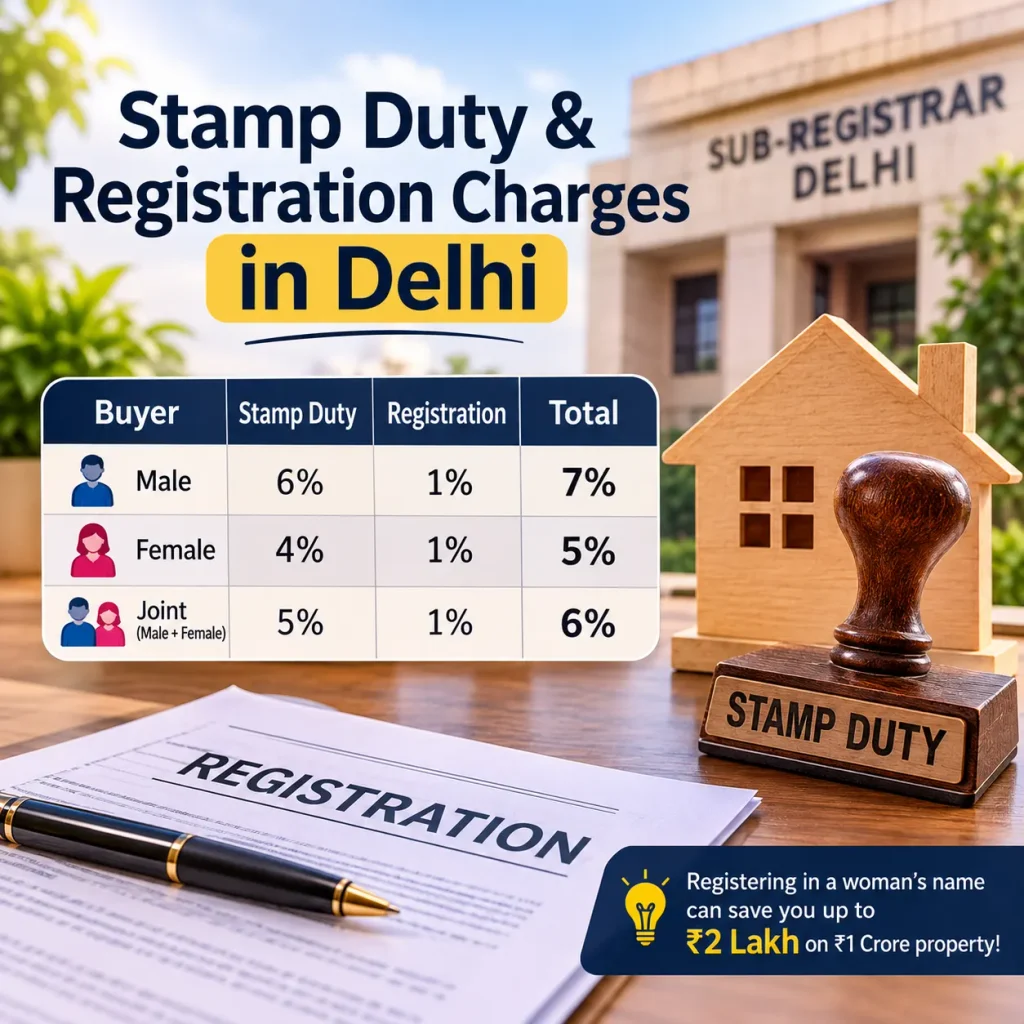
In Delhi, stamp duty is 6% for men, 4% for women, and 5% for joint owners (a man and a woman). Registration is an additional 1% for everyone. That makes the combined charge roughly 7% for a male buyer, 5% for a female buyer, and 6% for joint ownership.
Current rates at a glance
| Buyer | Stamp duty | Registration | Combined |
| Male | 6% | 1% | 7% |
| Female | 4% | 1% | 5% |
| Joint (male + female) | 5% | 1% | 6% |
One note of caution: some advisors quote an all-in government figure of up to 8%, depending on how they count transfer duty and other small fees. Before you finalise your budget, confirm the exact computation with your lawyer or at the sub-registrar’s office.
Why registering in a woman’s name makes a real difference
Delhi has one of the widest gender concessions in the country. On a ₹1 crore property, a female buyer pays ₹4 lakh in stamp duty against ₹6 lakh for a man. That’s ₹2 lakh saved, legally. If the property will genuinely belong to a woman in your family, whether that’s your spouse, mother, or sister, it’s worth discussing with your lawyer and CA. Just make sure the funds trail supports the registration, and think about estate planning too.
How Do Circle Rates Affect Property Registration?
Circle rates are the minimum values per square metre that the Delhi government sets for each area. Stamp duty and registration are charged on whichever is higher: the circle value or your agreement price. So if your deal is below the circle value, you’ll still pay duty on the circle figure.
The “higher of the two” rule in practice
Here’s how circle rate vs. market price of property in Delhi plays out. Say a South Delhi floor is priced at ₹6 crore, but the circle value works out to ₹3.5 crore. Duty is calculated on ₹6 crore, because the market price is higher. Now flip it: a ₹80 lakh deal in an area where the circle value comes to ₹1.1 crore. Duty is calculated on ₹1.1 crore, even though you’re paying less.
What if you buy below the circle rate?
You can, but there’s a catch. Under income tax rules, a gap between the circle value and what you paid, beyond a tolerance band (currently 10%), can be tax in your hands as income. Registration is also done on the higher value anyway. So it’s rarely a clever shortcut. Check the colony’s current circle rate before you finalise the deal, not at the registry.
What Hidden Costs of Buying Property in Delhi Should You Plan For?
The hidden costs of buying property in Delhi aren’t really hidden. They’re just scattered. Plan for brokerage, legal verification, loan charges, and the repairs or interiors you’ll want before moving in. Together, these can add another 2% to 5% of the price, sometimes more if you’re renovating.
Brokerage and GST
The market norm is 1% of the deal value from each side, plus 18% GST on the fee. On a ₹1 crore property, that’s ₹1 lakh plus ₹18,000. Agree on it in writing early, not at the registry.
Legal and verification fees
A lawyer checks the title, the chain of ownership, approvals, and pending dues, then drafts the agreement and sale deed. Depending on the property and its complexity, this typically costs anywhere from ₹40,000 to ₹2 lakh. It’s the cheapest insurance in the whole process. Skipping it to save a small amount can cost you far more later.
Loan processing and related charges
If you’re taking a home loan, banks usually charge processing fees of around 0.25% to 0.5% of the loan amount, along with valuation and legal charges. Keep in mind that stamp duty, registration, and brokerage come out of your own pocket. The loan is disbursed against the property price, not these extras.
Repairs, interiors and early maintenance
This is the line buyers underestimate most. A basic refresh can start around ₹2 lakh on a ₹1 crore flat. A full interior overhaul on a luxury floor can run into tens of lakhs. Add society or maintenance deposits, property tax transfer and utility changes, and keep a small buffer for the first year.
Worked Example: Total Cost of a ₹1 Crore Property in Delhi
Here’s a resale apartment priced at ₹1 crore, registered to a male buyer, with a ₹70 lakh home loan.
| Line item | Basis | Amount |
| Agreement value | — | ₹1,00,00,000 |
| Stamp duty | 6% | ₹6,00,000 |
| Registration fee | 1% | ₹1,00,000 |
| Brokerage (buyer’s side) | 1% + 18% GST | ₹1,18,000 |
| Legal fees | Estimate | ₹50,000 |
| Loan processing | ~0.5% of ₹70 lakh | ₹35,000 |
| Basic repairs and painting | Estimate | ₹2,00,000 |
| Total | ≈ ₹1,11,03,000 |
So the real answer for a ₹1 crore home is about ₹1.11 crore. If the same property is register in a woman’s name, stamp duty drops by ₹2 lakh, and the total comes to about ₹1.09 crore. If it were an under-construction purchase, add ₹5 lakh in GST.
Total Cost of Buying a Builder Floor in South Delhi: A Worked Example
Builder floors in South Delhi sit in a different price bracket, so percentages start to matter more. Let’s take a ₹6 crore resale floor in a prime colony, bought by a male buyer with a ₹3.5 crore loan.
| Line item | Basis | Amount |
| Agreement value | Market price (above circle value) | ₹6,00,00,000 |
| Stamp duty | 6% | ₹36,00,000 |
| Registration fee | 1% | ₹6,00,000 |
| Brokerage (buyer’s side) | 1% + 18% GST | ₹7,08,000 |
| Legal and title verification | Estimate | ₹1,00,000 |
| Loan processing | ~0.5% of ₹3.5 crore | ₹1,75,000 |
| Total before interiors | ≈ ₹6,51,83,000 |
Interiors are the wild card here. A refresh might cost ₹30 lakh, and a custom fit-out can cost far more, so a ₹6 crore floor can easily become a ₹6.8 crore commitment. A few things move this number:
- Register in a woman’s name: stamp duty falls to ₹24 lakh, saving ₹12 lakh.
- Buy under construction: 5% GST adds ₹30 lakh.
- TDS: the 1% (₹6 lakh) is deducted from the seller’s payment, not add to yours.
If you’re looking at premium homes, especially builder floors in South Delhi, you don’t need to do this alone. A luxury property dealer helps buyers shortlist verified properties, understand the full cost of each deal before they commit, and navigate the paperwork from token to registration.
How Do You Prepare a Realistic Property-Buying Budget?
Start from the price, add 8% to 12% for closing costs and early expenses, and then keep an extra buffer for interiors. Decide your funding mix (savings versus loan) before you negotiate, so you know exactly how much cash you’ll need at registration
FAQs (Frequently Asked Questions)
How much does it cost to buy a property in Delhi?
Plan on paying roughly 8% to 12% more than the agreed price. Stamp duty and registration make up most of that, usually 5% to 7% depending on who’s buying. Brokerage, legal fees, loan processing, and a basic repair budget fill the rest. On a ₹1 crore resale flat, that’s about ₹1.09 to ₹1.11 crore all-in.
What are the stamp duty and registration charges in Delhi?
Stamp duty is 6% for men, 4% for women, and 5% for joint owners (a man and a woman). On top of that, everyone pays a 1% registration fee. So the combined charge works out to about 7%, 5%, or 6%. Registering in a woman’s name saves ₹2 lakh on every ₹1 crore of property value, which is a legal and genuinely worthwhile saving.
Is stamp duty charged on the circle rate or the market price?
It’s charged on whichever is higher. If your agreement price is above the circle value, which is common in prime South Delhi colonies, duty is calculated on the price you pay. If the circle value is higher, you’ll pay duty on that instead, even though your deal is cheaper. Check the circle rate for your colony before you finalise the price, not on registration day.
What hidden costs should I budget for when buying property in Delhi?
The big ones are brokerage (usually 1% plus 18% GST), legal verification, loan processing fees, and early repairs or interiors. Under-construction homes also carry 5% GST, which resale homes don’t. One thing that trips people up is the 1% TDS on purchases above ₹50 lakh. It isn’t an extra cost, since it comes out of what you pay the seller, but you still need to file it properly.
How much does it cost to buy a builder floor in South Delhi?
Take a ₹6 crore resale floor bought by a male buyer: you’d pay about ₹36 lakh in stamp duty and ₹6 lakh in registration. Add brokerage, legal fees, and loan charges, and the total comes to about ₹6.52 crore before interiors. Fit-outs can easily add ₹30 lakh or much more. Registering in a woman’s name would cut ₹12 lakh from that bill.
Conclusion
Buying a home in Delhi is one of the biggest financial decisions you’ll make. The price on the listing is only part of the story. Once you add duties, brokerage, legal fees, loan costs, and the home’s early upkeep, the real number is usually 8% to 12% higher. Work it out early, and you’ll negotiate with confidence instead of scrambling at the registry.
Ready to find your home? Visit Onset Realty to explore current listings and get in touch with an advisor. Send over your preferred locality and budget, and ask for an all-in cost sheet before you make an offer. It’s a small step that can save you a lot of stress later.