


Ask around Delhi NCR about where to invest, and everyone will have a firm opinion, usually a different one.” Half will say South Delhi is the safest address you can own. The other half will say Gurgaon is where the growth is. Both camps have a point, and that is why the South Delhi vs Gurgaon property question is so hard to settle.
It really comes down to what you want from the asset. Some buyers want a legacy address that holds its value for decades. Others want faster appreciation, a better rental income, and a lower entry ticket. This guide compares Delhi vs Gurgaon real estate investment on the three things that matter most: price, rent, and long-term returns.
Property Prices: South Delhi vs Gurgaon
Price is where the two markets differ most, and it is usually the first thing buyers notice. The gap is wide enough to change what kind of home you can afford, and how much risk you carry while you own it.
What does South Delhi cost today?
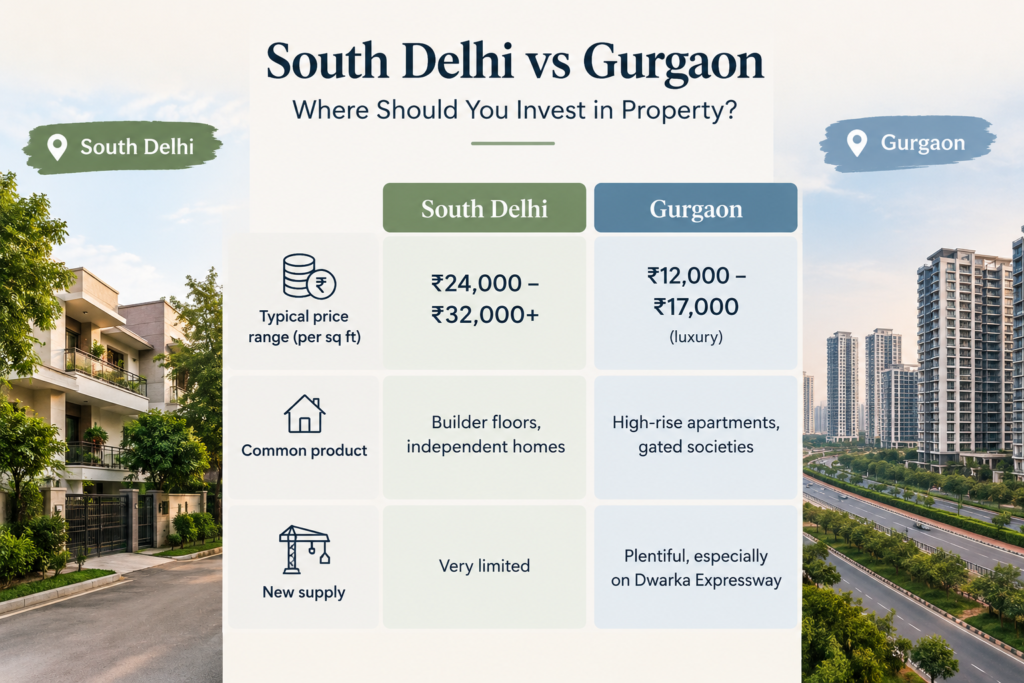
South Delhi is the most expensive residential market in the NCR, and it isn’t close. Established colonies like Greater Kailash, Hauz Khas, Saket and Green Park have recently sat in the ₹24,000 to ₹32,000 per sq ft range, according to CBRE data. Super-luxury addresses cost more, and prime pockets like Vasant Vihar can go well past ₹40,000 per sq ft for builder floors and independent homes.
Part of that premium is scarcity. There is almost no fresh land left, so every purchase is effectively a resale of a limited asset. You are paying for the postcode, the tree-lined streets, the schools, and the address itself.
What does Gurgaon cost today?
Premium and luxury projects in Gurgaon have been priced at roughly ₹12,000 to ₹17,000 per sq ft. Newer corridors like Dwarka Expressway and New Gurgaon come in lower still, and mid-segment homes there can start well under ₹10,000 per sq ft.
In practice, the same budget that gets you a modest apartment in South Delhi can get you a large, amenity-rich flat in Gurgaon, with a clubhouse, a pool and a gated community around it.
Comparing South Delhi Vs Gurugram
A fair comparison needs one caution. In South Delhi, you are often buying a floor in a low-rise building where the land share is a big part of the price. In Gurgaon, you are usually buying a high-rise apartment where the price includes amenities and a brand. These are different products, so a per-sq-ft figure only tells part of the story.
Rental Income: Rental Yield in South Delhi vs Gurgaon
Rental income is the part of property investing that people most often overestimate. A high price with modest rent leaves you with a thin yield, and that is the central issue in this comparison.
Why South Delhi yields stay low
Rental yield is simply annual rent divided by the property’s price. South Delhi’s prices are so high that even strong rents translate into a small percentage. Industry guides put yields in established South Delhi colonies at around 2%, and Delhi as a whole has moved from roughly 2.2% in 2019 to about 3.2% in 2026, based on Anarock data.
Add to that a tenant pool that is smaller and pickier. Large South Delhi homes are often owner-occupied, so when you do find a tenant, it is usually a diplomat, an expat, or a senior corporate executive. The rent can be excellent, but vacancy between tenants can hurt.
Why Gurgaon pulls ahead on rent
Gurgaon has the corporate engine that rental demand needs. Thousands of professionals working in offices on Golf Course Road, Cyber City and Udyog Vihar need somewhere to live nearby, and many prefer to rent. Anarock data shows Gurgaon yields rising from about 3.5% in 2019 to about 4.3% in 2026, and several market reports quote a 3.5% to 5% range for well-located properties.
That is a meaningful gap. On a ₹3 crore property, the difference between a 2% and a 4% gross yield is ₹6 lakh a year.
The net yield reality check
Whichever side you pick, remember that gross yield is not what lands in your account. Maintenance, property tax, vacancy, and repairs typically bring net yields down to somewhere around 2.5% to 3.5%. In NCR, rent is a pleasant bonus, but it is rarely the reason to buy. Appreciation does the heavy lifting, which brings us to the next point.
Long-Term Returns: South Delhi vs Gurgaon Property Appreciation
This is where the comparison becomes most interesting, because the two markets have moved at very different speeds.
How fast has each market grown?
Anarock’s data tracking prices from 2019 to the second quarter of 2026 shows the contrast clearly. Gurgaon’s average capital values rose from about ₹6,150 to ₹13,350 per sq ft, a jump of roughly 117%. Delhi moved from about ₹18,200 to ₹26,700, a rise of around 47%.
JLL’s Q2 2026 report points the same way. Gurgaon led NCR with annual price growth of about 10%, while Delhi saw more modest quarterly gains of around 1%. Analysts expect Gurgaon and Noida to anchor the next phase of the upswing, with Delhi growing at a steadier, slower pace.
What is driving Gurgaon’s growth?
A few things work in Gurgaon’s favour. Corporate expansion keeps bringing in high-income buyers and tenants. The Dwarka Expressway has opened up a direct link to South and West Delhi, which has lifted values along that corridor. Gurgaon also takes the largest share of new launches and sales in the NCR, which gives it constant momentum.
The flip side is that fast growth can mean uneven growth. Some micro-markets have already run up sharply, and a project’s builder, location, and delivery track record matter far more here than in an established colony.
What is South Delhi’s real strength?
South Delhi’s case rests on stability. Its infrastructure is mature, supply is tightly capped, and the buyer base is deep and wealthy. Prices here tend to move slowly, but they rarely fall hard. During softer market phases, super-luxury values have corrected somewhat, yet the broader market has stayed steady.
There is also a value that does not show up in a spreadsheet. A well-located South Delhi independent floor or kothi is something a family can hold for generations. Land does not get built again, and that is the whole point.
So which one wins on returns?
If you measure purely on growth rate and rental yield over the next 5 to 10 years, Gurgaon has the stronger numbers. If you measure on capital preservation, prestige, and a 10-year-plus holding period, South Delhi has a case that is hard to beat. A realistic total return in NCR is net rent of roughly 2.5% to 3.5% plus appreciation of 5% to 8% a year, though Gurgaon’s recent run has been stronger than that.
Who Should Choose What?
Instead of declaring a winner, it helps to match the market to the buyer.
South Delhi suits you if:
- You want a home to live in, or to hold for a decade or more
- You value a legacy address, independent floors and low-density living
- Capital safety matters more to you than a quick gain
Gurgaon suits you if:
- You want higher rental income and faster appreciation
- You prefer modern high-rises with amenities
- Your budget is limited, or you want to spread it across a larger asset
Many seasoned investors do not choose at all. They put a core holding in South Delhi for security and a smaller share in a growing Gurgaon corridor for upside.
Frequently Asked Questions
Is South Delhi a better investment option than Gurgaon?
It is contingent upon what you want to do. If you are looking for safety of capital, prestige, and long-term holding, South Delhi is far superior, for land is scarce and demand continues to be high. Gurgaon provides better rental yields, faster appreciation, and a lower entry price. If growth is the bottom line, Gurgaon has the edge. If stability is the most important thing, South Delhi does.
Is Gurgaon costlier than South Delhi?
South Delhi is much more expensive. Established colonies have recently been priced around ₹24,000 to ₹32,000 per sq ft, and prime areas like Vasant Vihar can go beyond ₹40,000. Luxury projects in Gurgaon have been priced at around ₹12,000-₹17,000 per sq ft. Usually, the same budget gets a much bigger home in Gurgaon.
Where is rental yield higher?
In most cases, Gurgaon. Its gross yields are in the range of 3.5% to 5%, bolstered by robust demand from corporate professionals. In South Delhi, the yields are lower, ranging from 2% to 3% and more, because of the very high property prices. Keep in mind both markets have lower net yields after maintenance, tax, and vacancy.
Which market has had better appreciation in the last few years?
Gurgaon has grown faster. Its average prices rose about 117% between 2019 and Q2 2026, against about 47% for Delhi, according to Anarock data. JLL also reported Gurgaon leading NCR with approximately 10% annual price growth in Q2 2026. South Delhi has seen a more gradual but consistent growth.
Is It Good To Invest In South Delhi And Gurgaon Both?
Yes, for many investors. A South Delhi property can provide stability and a legacy address to your portfolio, while a Gurgaon property offers rental income and growth. Putting your investment in both spreads your risk. Don’t just look at city-wide averages. Look at specific projects and micro-markets pre-purchase.
Conclusion
So, is it better to buy in South Delhi than Gurgaon? Gurgaon wins on yield, price growth, and entry cost on paper. On scarcity, stability, and status – South Delhi wins. Both responses are correct. They are only designed for different purposes.
If South Delhi feels like the perfect place, the next step is to find the appropriate home with the right counsel. That’s where Onset Realty, a reputable luxury property dealer in Vasant Vihar, can help. Onset Realty serves buyers and investors seeking premium houses in Vasant Vihar and nearby South Delhi localities. “The team knows a purchase at this level is about more than square footage. It’s about the address, the place, the community, and the longevity of the address.