

If you’re house-hunting in Delhi, you’ve probably already had this argument with yourself (or your family) at least a few times. One side of you pictures a builder floor in a nice old colony: your own floor, a quiet staircase, and a slice of land that’s yours on paper. The other side pictures an apartment in a proper society, with a guard at the gate, a lift that works, and maybe a gym downstairs you’ll swear you’ll use.
Both sound great, and that’s exactly the problem. So, is it better to buy a builder floor or an apartment in Delhi? Honestly, it depends on what you need from the place: your budget, who’s going to live there, whether it’s a home or an investment, and how much you care about privacy versus convenience. Let’s walk through the builder floor vs apartment in Delhi question step by step so you can land on the one that actually suits you.
What Is the Difference Between a Builder Floor and an Apartment?
A builder floor is one independent floor of a low-rise building, usually three to four storeys, built on a single residential plot in an established colony. An apartment is a unit in a larger multi-storey complex or society, with shared common areas, shared facilities, and a managing body. In short, a builder’s floor feels like a small private house, while an apartment feels like part of a community.
With a builder floor, you typically own the floor along with a proportionate share of the land beneath the building. The building usually has only a handful of units, often one per floor, and parking is commonly provided at stilt level. Colonies like Greater Kailash, Defence Colony, Vasant Vihar’s neighbouring pockets, Rajouri Garden and Punjabi Bagh are well known for this format.
Apartments, on the other hand, sit in large projects with dozens or even hundreds of units. You own the flat and share ownership of the common areas. These projects usually come with a resident welfare association, a maintenance agency, and amenities like a clubhouse, power backup, and landscaped grounds. If you’re weighing a builder floor vs. a flat in Delhi, this structural difference is the root of nearly every other contrast that follows.
Builder Floor vs Apartment in Delhi: Key Differences
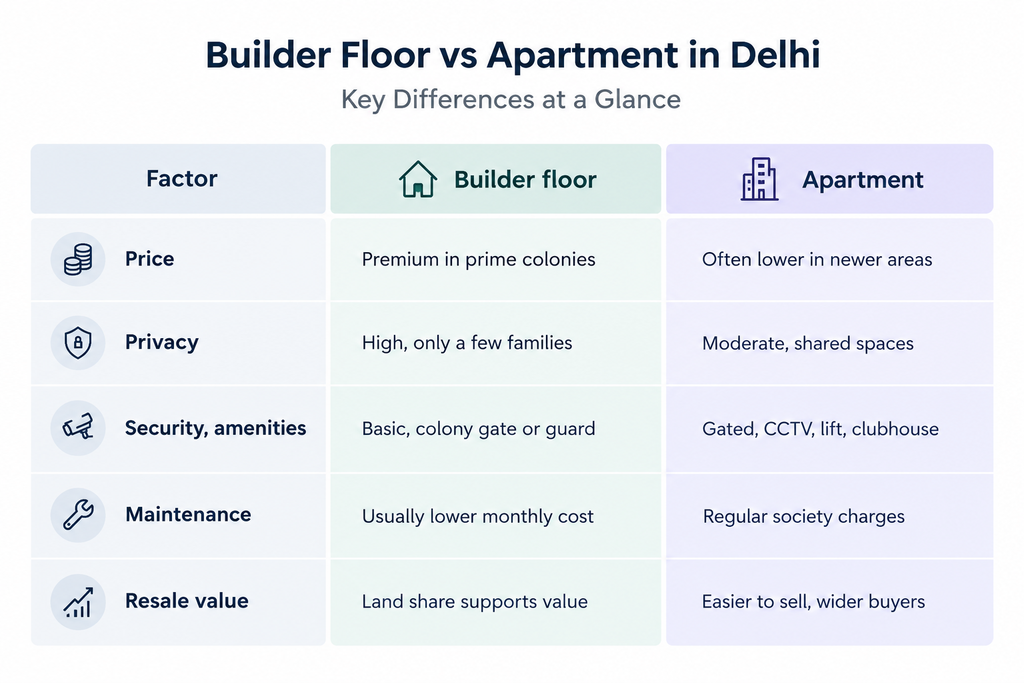
Broadly, builder floors win on privacy, land share and location in prime established colonies, while apartments win on security, amenities and organised management. Builder floors tend to cost more per square foot in central areas, but apartments can carry higher monthly outgoings. Neither is universally better; each trades one set of advantages for another. Here’s how they compare on the factors that matter most.
Purchase Price and Overall Cost
When looking at builder floor vs apartment price in Delhi, the per-square-foot rate usually favours apartments in newer, peripheral areas, while builder floors command a premium in prime central and southern colonies. The reason is simple: you’re buying a share of expensive land in a sought-after neighbourhood, not just a built-up unit.
Don’t stop at the sticker price, though. Add registration and stamp duty, which depend on the circle rate and the buyer’s profile. For apartments, budget for club membership or maintenance deposits where applicable. For builder floors, factor in the cost of parking arrangements and any modifications you want to make. A cheaper-looking apartment with hefty recurring charges can end up costing as much over ten years as a pricier floor with almost no overheads.
Privacy and Lifestyle
Privacy is where builder floors shine. With only a few families in the building, you know your neighbours, the stairwell is quiet, and there’s little footfall. Many floors also come with a terrace or a balcony that feels like your own, and you often get more natural light and ventilation because the building is low-rise and surrounded by open colony lanes.
Apartments offer a different lifestyle: a ready-made community, kids’ play areas, jogging tracks, and festivals celebrated together. If you enjoy that social buzz, or you work long hours and like having things handled for you, a complex can feel far more convenient. If you prefer closing your door and hearing nothing, a builder floor is hard to beat.
Security and Amenities
This is the apartment’s strongest card. Gated societies generally offer guards at the entrance, CCTV, visitor management, power backup, and sometimes fire-safety systems that are professionally maintained. Add a gym, swimming pool, or community hall, and daily life gets noticeably easier, especially for older residents and families with young children.
Builder floors have improved but still lag. Security often depends on a colony gate, a shared guard, or the neighbours themselves. Lifts are not guaranteed, so climbing to the third or fourth floor is a real consideration for senior citizens. If amenities and round-the-clock security are non-negotiable for you, an apartment is the safer bet.
Maintenance Costs
If you’re wondering which has lower maintenance costs, a builder floor or an apartment, the honest answer is that a builder floor usually does. With few units and no clubhouse, pool, or lifts to run, there’s no heavy monthly bill. You pay for what you actually use, and repairs are shared among a small group of owners.
Apartments charge monthly maintenance to cover security, housekeeping, lifts, power backup, landscaping, and facility upkeep. In large, amenity-rich projects, this can be a significant recurring expense. The upside is that someone else is responsible for the upkeep of the building. With a builder floor, you and your co-owners handle repainting, plumbing issues, and the building’s overall condition, and that works well only when everyone cooperates.
Resale Value and Investment Potential
On the question of which has better resale value, a builder floor or apartment in Delhi, location and land share drive the answer more than the format. Builder floors in established, high-demand colonies often hold value well because the land component appreciates over time, even as the structure ages. This is especially visible when comparing builder floors vs apartments in South Delhi, where scarce land and strong demand support prices.
Apartments in well-run, well-located societies are easier to sell, though. Buyers know the format, banks lend readily against them, and amenities make the property appealing to a wide pool. Older floors can face a tougher resale if the building is ageing and the neighbours disagree on redevelopment. The takeaway: the resale value of a builder floor is closely tied to colony and plot quality, while an apartment’s depends on the society’s reputation and upkeep.
Is a Builder Floor or Apartment Better for Families?
For most families, the better choice comes down to who lives in the house. Joint families and those who value space and privacy usually prefer builder floors, while families with young children, working parents, or elderly members often find apartments more comfortable because of the security, lifts, and amenities. Neither suits everyone, so match the property to your daily routine.
Think about a typical day. If you have a toddler, a play area within the complex and a guard at the gate offer real peace of mind. If you have parents with knee problems, a working lift matters more than a larger terrace. On the other hand, if you want a separate kitchen garden pot setup on the terrace, or you host big family gatherings and dislike being watched by a society committee, the independence of a builder floor will feel liberating.
Also consider future needs. A growing family may want to stay put for fifteen or twenty years, and a floor with a share of the land gives a long-term anchor. Meanwhile, if you may relocate in five years, the easier liquidity of a good apartment could be worth more than the extra privacy.
Which Property Is Better for Investment in Delhi?
Investors should compare the two on three parameters: capital appreciation, rental yield, and ease of exit. Builder floors, especially in premium colonies, usually offer better long-term appreciation because they include a land component. Apartments have a steadier rental demand and are easier to resell. So, when you are comparing a builder floor vs. flat for investment, your goal is what determines the winner.
Hard to ignore capital growth in a premium locality with a floor. Delhi has limited land, and a well-located plot never goes out of demand. Apartments in societies located near metro stations, offices, and schools generally quickly find tenants for rental income, including corporate and expatriate tenants who prefer managed complexes. Strong rents can also be paid for central colony floors, but tenant turnover and the condition of the building are more important.
The last test is the exit plan. Apartments in desirable developments are typically easier to finance and sell faster. Floors can command a premium in the right pocket but may take longer to find the right buyer. A well-rounded investor may even own one of each. Just remember returns are a function of buying at the right price in the right micro-location with clean paperwork.
What Should You Check Before Buying a Property in Delhi?
Before you hand over a token amount, slow down and do your homework. Most property regrets in Delhi come from a rushed decision, not a bad market. The good news is that almost every problem can be spotted early if you know where to look, and a few days of checking can save you years of stress.
Here’s what to look into, whether you’re eyeing a builder floor or an apartment:
Who actually owns it?
Ask for the full chain of documents and make sure the seller has a clear title. Find out whether the property is freehold or leasehold, because that affects loans, transfers, and resale.
Does the building match the approved plan?
Check that the plan is sanctioned by the municipal authority and that what’s been built is what was approved. Extra floors or add-ons that were never cleared can cause headaches later.
Is the colony regularized?
This matters more than people think. If the colony’s status is uncertain, getting a home loan and finding a buyer later can both get difficult.
Is the project RERA-registered?
For apartments, this is a basic check. Smaller builder floor projects may fall outside RERA, so in that case a lawyer’s review becomes even more important.
What shape is the building in?
For an older property, it’s worth paying an engineer to look at it. Seepage, cracks, old wiring, and tired plumbing can quietly eat into your budget.
Is your parking in writing?
A verbal promise of a parking spot means nothing. Make sure it’s documented in the agreement.
Are there any dues, loans, or legal disputes?
Ask for a no-dues certificate and confirm there’s no existing mortgage or litigation attached to the property.
What’s the neighbourhood like at different times of day?
Go in the morning, at rush hour, and at night. You’ll get a real sense of the noise, traffic, water supply, and power reliability.
Once you’re satisfied, get a lawyer to go through the agreement before you sign anything. And don’t just rely on the broker’s word on price. Look at what similar properties nearby have actually sold for, so you know you’re paying a fair amount.
FAQs (Frequently Asked Questions)
Should I buy a builder floor or a flat in Delhi?
It is contingent upon what is more important to you. Choose a builder floor if you desire privacy, a land share, and a position in an established colony. If you want security, facilities, and a professionally maintained property, then go for an apartment.
Does a builder floor or flat have a cheaper upkeep cost?
Builder floors are cheaper to maintain as a monthly outflow, as there are no shared amenities to pay for. Apartments charge for normal upkeep for security, lifts, power backup, and common utilities.
Builder floor or flat in Delhi – which has better resale value?
Either can be good. Builder floors in excellent colonies appreciate with land cost, while flats in recognised societies have a faster turnover and are easier to finance. Most important is the condition and location.
Is a builder floor a good investment option?
It can be, particularly in desirable places where land is at a premium. Verify the title, consents, and the state of the building thoroughly since these will directly impact future worth.
Are builder floors safe to live in?
Most are, but not all are safe. Before you commit, look at the construction quality, approved blueprints, fire escapes, and colony security. Generally, the safety procedures are more standardised in apartments in gated communities.
Conclusion
At the end of the day, there’s no universal winner in the builder floor vs apartment debate. It comes down to how you want to live. If you love the idea of more space, a quieter building and a share of the land in a good colony, a builder floor is worth a close look. If you’d rather have a guard at the gate, a working lift and neighbours close by, an apartment will probably make daily life a lot easier.
Whichever way you’re learning, take your time. Check the paperwork, visit the place more than once, compare prices around the neighbourhood, and ask yourself where you’ll be in ten years. A home that fits your life is worth far more than one that just looks good on paper.
And if you’d like a second pair of eyes, you don’t have to figure it all out alone. A professional team like Onset Realty can help you compare builder floors and apartments across Delhi’s prime localities, narrow down options that suit your budget, and guide you through the buying process.